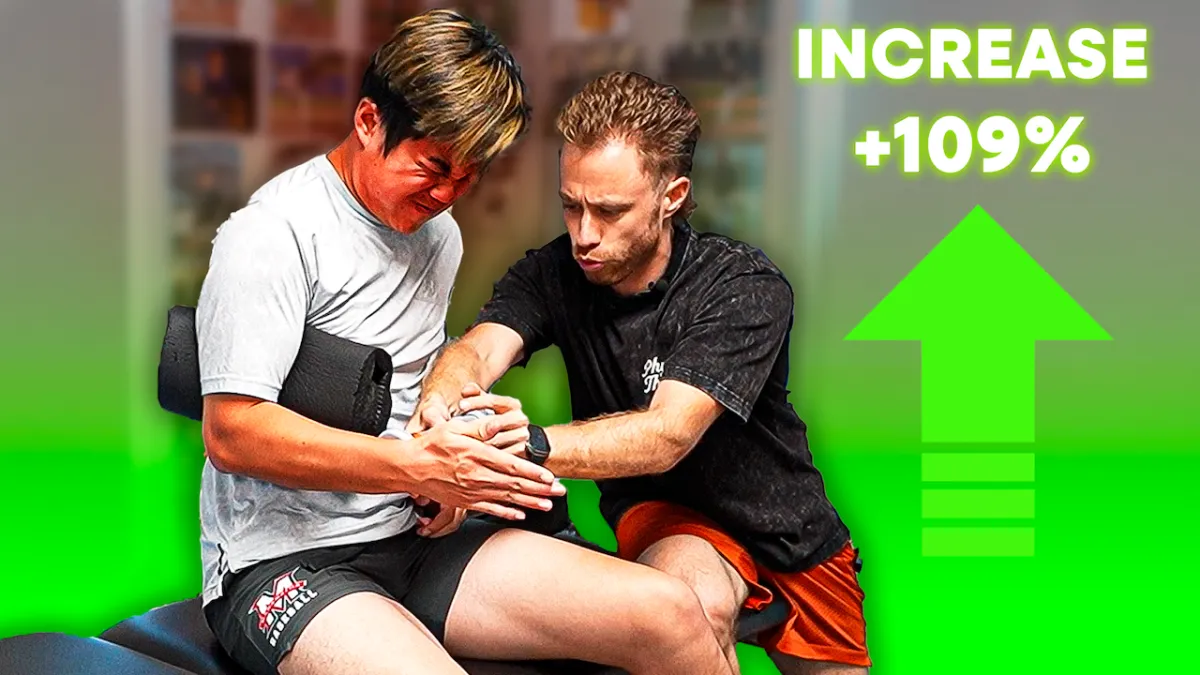
What a Real Evaluation Looks Like for a Throwing Athlete
What a Real Evaluation Looks Like for a Throwing Athlete
Why Athletes Struggle to Trust Their Shoulder Again
Shoulder pain can be confusing for any throwing athlete.
You may feel “stronger,” but have no idea if your shoulder is truly ready for throwing stress.
That uncertainty is exactly what leads to re-injury or stalled progress.
As a sports physical therapist who runs objective testing every day, I see this problem constantly.
Athletes guess their way through rehab because no one ever shows them what a real shoulder strength test should measure.
In this post, I’ll break down a live shoulder re-evaluation from one of my baseball athletes and show you the exact process we use to determine if someone is cleared to throw safely.
How We Begin a Complete Shoulder Strength Test
The session always starts with the athlete's biggest question: “Is my shoulder actually ready?”
Before touching a plyo ball or making a throw, we check mobility, posture, and side-to-side symmetry.
This athlete originally came in with his right shoulder sitting lower than the left.
On retest, both shoulders were level ... one of the first signs that his scapular position had normalized.
We also retested his cross-body mobility, where he previously struggled.
That limitation was gone, earning him the first two “high fives” of the day.
Objective Data: Measuring Real Strength Gains
A true shoulder strength test doesn’t rely on feel or guessing.
We use a digital dynamometer to measure pounds of force on every plane of motion.
His results?
Right shoulder strength up 21.8%
Left shoulder up 10%
Right side finally stronger than the left
Multiple categories showing double-digit improvements
He didn’t miss a single day of his program and the data showed it.
By the end of the test, he earned seven high fives because he beat his previous numbers in every category.
This is what a real return-to-throw decision is built on, not hope, not vibes, not “I think it feels better.”
Why Plyometrics Matter After a Shoulder Strength Test
Strength alone isn’t enough for throwers.
You must also show that your shoulder can handle fast, elastic movements.
We moved into arm-care plyometrics, starting with simple rebounds and progressing to rotational plyo throws.
He passed each one with clean movement and zero pain.
We cued timing between the glove arm and throwing arm because elite throwers time their body like dancers.
Once his upper and lower half synced up, his plyo throws looked effortless.
If you move well, don’t compensate, and report no pain during these drills, you're typically ready for light throwing.
The Final Step: Throwing Pain-Free at Controlled Distance
With mobility, symmetry, strength, and plyos all passed, we tested his throwing at 60 feet.
This was his first time throwing in almost a month.
He threw pain-free.
His arm felt loose.
He said the ball “came out good,” which is exactly what we hope for after restoring scapular mechanics and strength.
Based on his performance, we built him a structured throwing progression starting at 60 feet and extending over four weeks until he reaches the mound safely.
What Actually Helped Him Recover?
When asked what made the biggest difference, his answer was simple:
Consistency.
He didn’t miss a day.
He followed each part of the program exactly as written.
And because he stayed consistent, the strength numbers told the story and his shoulder was no longer the weak link.
That is what every thrower needs to understand.
You probably came here wondering what a real shoulder strength test looks like and how to know if a throwing athlete is truly ready.
Remember... A complete evaluation doesn’t rely on guessing.
It combines posture, mobility, objective strength numbers, plyometric testing, and controlled throwing.
When all five pieces line up, just like they did for this athlete, you can return to throwing with confidence instead of fear.
I help baseball and softball athletes eliminate pain, fix mechanics, and build velocity through data-driven rehab and performance training, both in-person and online.
If you want to learn more, here are helpful follow-ups:
Or, if you’re dealing with shoulder pain right now, you can apply to work with me online or in-person.
